2.1 Pressure is increasing
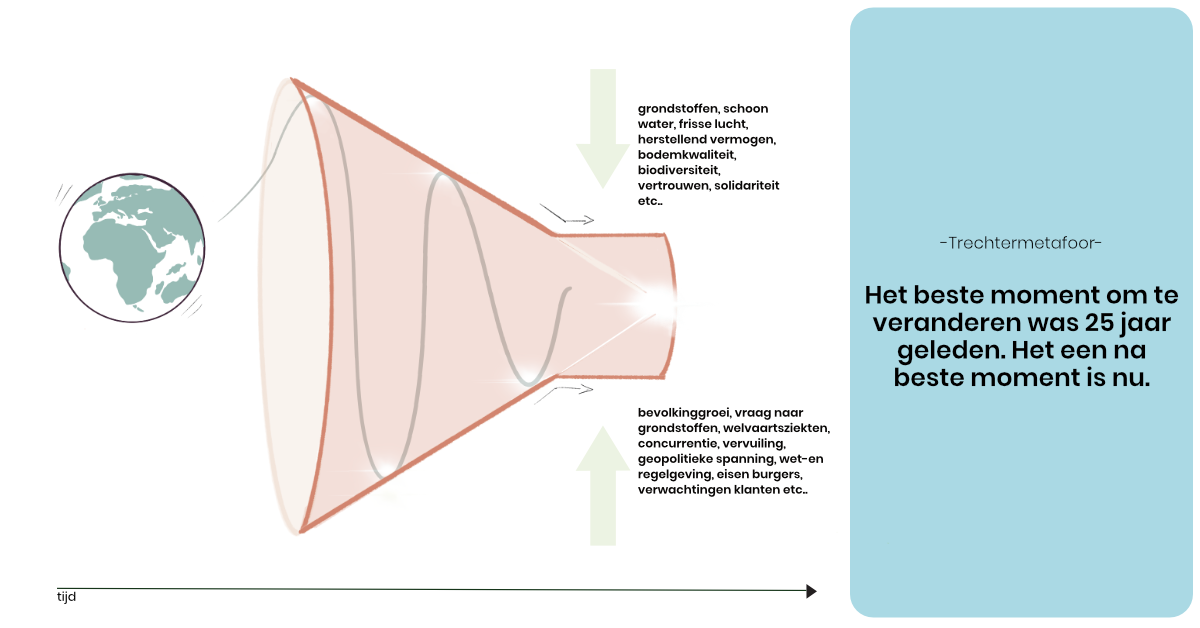
The pressure on our society is increasing. Compare it to a funnel. We clarify this through the image below.
More and more
The bottom of the funnel can be read as an ascending line that represents the increasing pressure from society. Such as world population growth, global prosperity, demand for products and raw materials, pollution and citizen demands.
Less and less
The top of the funnel can be read as a downward line representing everything we are getting less and less of. Like potable water, raw materials, clean air, fertile soil and biodiversity but also, for example, equality or trust in the government, in science and in each other.
Everything reinforces each other
Developments reinforce each other. For example, with an increasing population and at the same time an increase in prosperity, consumption increases extraordinarily powerfully: more cars, eating more meat, flying more, etc. The moment the two lines meet (see the green dotted line), our way of life is no longer possible.
Why taking action today is better than later
Imagine the following: put this funnel upright and throw a marble into it. At the outer edge, the marble will circle through the funnel relatively slowly. But the closer we get to the opening at the bottom, the more often it collides with the walls and it will circle faster and faster. The room to move around the rudder decreases more and more (red dotted line) and the rate at which we collide with the walls increases.
More often and more quickly we will bump into the walls
Consider, for example, the nitrogen crisis, the PFAS crisis, the financial crisis of 2008, the discontent of teachers, builders and farmers on Malieveld, the Groningers and their cracked houses, the scandal surrounding Volkswagen and its sham software, the heat stress, the flooding, the storms that get names, the Ebola outbreak, the fires in Australia, the lack of affordable housing and, of course, the Corona pandemic.
What can we do?
We will have to make sure that the two green dotted lines do not cross each other. We can deflect the lines by reducing our impact. We can even make the lines diverge again. We can achieve this by restoring functions of our natural system, such as good soil management, reforestation, using CO2 for products, taking fishing nets out of the sea, etc. You’ll read more about this in Chapter 3.
Yes we can
This may sound like an impossible task, but it certainly isn’t. In fact, we’ve managed it before; we gave the ozone hole a chance to largely recover* when we banned all CFCs.
*Good to know that the hole is not completely gone. CFCs take more than 100 years to break down and with extremely cold temperatures at the poles, these CFCs still cause the “hole” to temporarily get bigger and smaller.
Midgley developed CFCs in 1930, with the goal of developing a durable, non-flammable, non-aggressive gas that was harmless to inhale. At the time, we had numerous technological problems for which CFCs provided a solution. Consider the refrigerator with dangerous gases that still leaked at times. One refrigerator leak at a hospital in Cleveland, Ohio led to the deaths of as many as more than 100 people. The advent of CFCs, for example, made the refrigerator much safer. CFCs have also been used in car air conditioners and deodorant sprays.
CFCs did turn out to be very harmful years later. Midgley never knew the harmfulness of CFCs and he died long before anyone realized how harmful CFCs are. Good to keep CFCs in mind for the next section on the importance of systems thinking.