6.2 Step by step to the future
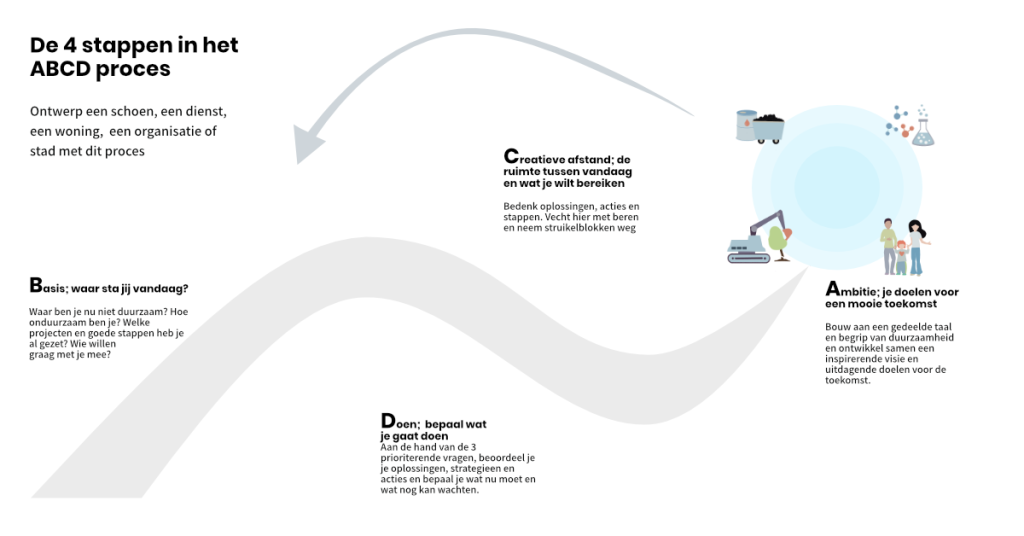
Thanks to the 4 principles and backcasting, we have an ABCD process that allows us to become more sustainable step by step. The most remarkable thing about this ABCD process is that you can use it to design a sustainable neighborhood—or even a sustainable pen.

The steps explained
A: Ambition and attention
Note: Help everyone speak the same language when it comes to sustainability and ensure a shared understanding.
Ambition: Define your ultimate goal; what do you want to achieve with your organization or project? Together with all stakeholders, you will develop a powerful vision and inspiring strategic goals for your project or the entire organization.
B: Basic
What is your starting point? Where do you stand today in relation to what you want to achieve?
Analyze “today.” Quantify what you use and consume, identify how much material you have on hand, review which projects are currently underway, and assess the expertise you already possess. What talents do you still need? Map out everything that helps or hinders you on the path to your goal. Above all, look for others who have already had the same experience. You can view this step as a baseline measurement—your starting point.
C: Creative ideas
How do we get from today to tomorrow? Thanks to steps A and B, you suddenly see the significant gap between where you want to be and where you are today. You’ll bridge that gap with step C. You do this together with others: you organize creative sessions to come up with ideas. Engage, inspire, share, and learn with others. Together, you’ll come up with ideas to get from B to A. And above all, invite lots of new thinkers—unexpected people who come up with unexpected ideas. Because if you always work with the same people, the chance of surprising ideas is smaller.
D: Do
Time for a good dose of “feet on the ground.” We’re now going to evaluate all the ideas and map them out over time. Determine what is feasible and when, figure out how you will measure progress (choose indicators), and translate your ideas into short- and medium-term plans. Assign names and roles to these plans. In this step, you’ll also figure out what tools you need. Choose only tools that fit your plans.
In step D, you review and prioritize all the ideas from step C
Once you’ve gathered plenty of ideas and strategies in Step C, you can start evaluating and prioritizing them. We use the 3 Prioritization Questions for this:
- Are we heading in the right direction? Are we moving toward our goals and the four principles? In short, are we becoming more sustainable?
- Is this a flexible step? Are we setting ourselves up for trouble if we aren’t yet 100% sustainable? Can we still change course down the line?
- Does it provide enough value for our organization? (e.g., revenue, business continuity, property value, customer value, cost savings, communication, setting an example, support, risk reduction)